
The first meal I gave my puppy was a disaster.
I had bought a bag of puppy food — the same brand the breeder had recommended. I put what seemed like a reasonable amount in the bowl. My puppy ate it in approximately forty-five seconds, looked up at me with an expression that communicated absolute certainty that I had given him approximately one-tenth of what was required, and then sat beside the empty bowl staring at me for the next twenty minutes.
I gave him more. He ate that too. Within two hours, he had vomited everything on the kitchen floor and was sprawled out looking deeply sorry for himself.
I had overfed him. I had not read the feeding guide on the bag. I had no idea how much a puppy that size needed, how often he should eat, or that puppies have small stomachs that are easily overwhelmed.
That experience — and the research I did afterward — forms the foundation of this guide. Everything I wish I had known before that first meal.
Why Puppy Nutrition Is Different From Adult Dog Nutrition
Puppies are not small adult dogs. Their nutritional requirements are fundamentally different from adult dogs in several important ways, and understanding why helps explain every feeding decision covered in this guide.
Rapid Growth
A puppy’s body grows at a rate that has no equivalent in adult life. A Labrador puppy grows from approximately five hundred grams at birth to thirty kilograms or more within twelve months. This explosive growth requires dramatically higher levels of protein, calories, calcium, phosphorus, and other nutrients than adult maintenance requires.
Puppy food is formulated to meet these elevated requirements. Adult dog food is not.
Developing Organ Systems
The digestive system, kidneys, liver, and immune system of a young puppy are not fully developed. Puppies process food differently from adults — they are more efficient at absorbing certain nutrients but also more sensitive to excesses and deficiencies. Getting nutrition right during this developmental period has consequences that extend throughout the dog’s entire life.
Small Stomach, High Caloric Needs
Puppies need more calories per kilogram of body weight than adult dogs, but their stomachs are small relative to those caloric needs. This combination means puppies need to eat frequently throughout the day — small meals spread across multiple feeding times — rather than the once or twice daily schedule suitable for adults.
Bone and Joint Development
Calcium and phosphorus are critical for bone development — but the ratio between them matters as much as the absolute amounts. Too little calcium causes weak, malformed bones. Too much calcium — from over-supplementation — causes developmental orthopedic disease, particularly in large and giant breed puppies, where rapid growth already stresses the skeletal system.
Puppy foods are formulated with the correct calcium-to-phosphorus ratio for appropriate skeletal development. Supplementing calcium on top of a complete puppy food disrupts this balance and should never be done without specific veterinary guidance.
Choosing the Right Puppy Food
What to Look For
AAFCO statement for growth — look for a statement from the Association of American Feed Control Officials that the food is formulated to meet nutritional levels for growth or all life stages. This statement confirms the food has been tested or formulated to meet the nutritional standards for puppies. A food without this statement is not appropriate as a primary puppy diet.
Named animal protein as the first ingredient — chicken, turkey, beef, lamb, or salmon should be listed as the first ingredient. This indicates a food with meaningful animal protein content rather than one primarily based on plant ingredients.
High protein content — puppy food should contain at least twenty-two to twenty-eight percent protein on a dry matter basis. Growing puppies need significantly more protein than adults to support muscle development, organ growth, and immune function.
Appropriate fat content — fat provides energy and essential fatty acids. Puppy food should contain at least eight to ten percent fat. The DHA content is particularly important — DHA is an omega-3 fatty acid that supports brain development and vision in growing puppies. Look for fish oil or DHA on the ingredient list.
Calcium and phosphorus levels — for large and giant breed puppies, this is particularly critical. More on this below.
Large Breed vs Small Breed Puppy Food
One of the most important feeding decisions for puppy owners is choosing between standard puppy food, large breed puppy food, and small breed puppy food. This is not marketing differentiation — these formulations are genuinely different in ways that matter for the specific dogs they are designed for.
Large breed puppy food — formulated for breeds expected to exceed twenty-five kilograms at adult weight — is specifically designed to support controlled, appropriate growth rates. The calcium and phosphorus levels are carefully calibrated to promote healthy bone development without accelerating growth to the point where the skeletal system cannot keep up.
Large breed puppies fed standard puppy food — which contains higher calcium and caloric levels appropriate for smaller breeds — can develop developmental orthopedic conditions, including osteochondrosis, hip dysplasia, and angular limb deformities. The damage caused during the growth phase may be permanent.
If you have a large or giant breed puppy — Labrador, Golden Retriever, German Shepherd, Rottweiler, Great Dane, Bernese Mountain Dog, and similar — always choose a large breed puppy formula.
Small breed puppy food — formulated for breeds expected to remain under ten kilograms — addresses the opposite set of considerations. Small breed puppies have higher metabolic rates per kilogram of body weight than large breed puppies and need more calories per gram of food. Small-breed puppy foods are more calorie-dense and often have smaller kibble sizes that are more appropriate for small mouths.
Wet vs Dry Puppy Food
Both wet and dry food formulated for puppies are appropriate. As with adult dogs, wet food provides better hydration and is generally more palatable. Dry food is more convenient and cost-effective.
Many puppy owners use a combination — dry puppy kibble as the primary diet for convenience and cost, with wet puppy food mixed in or offered separately to boost palatability and hydration.
If transitioning a puppy from the food used by the breeder or shelter, do so gradually — as described in the transition section below.
How Much to Feed a Puppy
The question most new puppy owners ask first — and the one that caused my first feeding disaster — is how much to feed.
The honest answer is that there is no universal amount. The right quantity depends on the puppy’s age, size, breed, growth rate, activity level, and the specific food being fed. The feeding guide on the food packaging is the most practical starting point — but it is a guideline, not an absolute rule.
Reading the Feeding Guide
Every bag of puppy food contains a feeding guide that recommends amounts based on the puppy’s current weight and expected adult weight. Follow this guide initially. Adjust based on body condition — more on this below.
Feeding guides are typically given as daily totals divided across multiple meals. They are generally slightly generous — most puppies do well on slightly less than the guide suggests, while a few very active or fast-growing puppies need slightly more.
Monitoring Body Condition
The feeding guide is a starting point. The puppy’s body condition tells you whether the amount is right.
Run your hands along the puppy’s ribcage. You should be able to feel each rib easily with gentle pressure — but the ribs should not be prominently visible or feel sharp. Looking from above, there should be a slight waist behind the ribs. Looking from the side, the abdomen should tuck up slightly from the chest toward the hindquarters.
If the ribs are hard to feel through a thick layer of fat, the puppy is overweight — reduce the portion slightly. If the ribs are very prominent and the waist is extremely pronounced, the puppy is underweight — increase the portion slightly.
Check body condition weekly during the rapid growth phase and adjust feeding accordingly.
Approximate Daily Amounts by Puppy Size
These are rough starting points based on average puppy food caloric densities. Always cross-reference with the specific feeding guide for the food you are using.
Toy breeds — adult weight under 5 kg:
- Eight weeks: thirty to fifty grams of dry food per day
- Twelve weeks: forty to sixty grams per day
- Six months: fifty to eighty grams per day
Small breeds — adult weight five to ten kg:
- Eight weeks: fifty to ninety grams per day
- Twelve weeks: seventy to one hundred and twenty grams per day
- Six months: one hundred to one hundred and fifty grams per day
Medium breeds — adult weight ten to twenty-five kg:
- Eight weeks: one hundred to one hundred and fifty grams per day
- Twelve weeks: one hundred and fifty to two hundred and fifty grams per day
- Six months: two hundred and fifty to three hundred and fifty grams per day
Large breeds — adult weight twenty-five to forty-five kg:
- Eight weeks: one hundred and fifty to two hundred and fifty grams per day
- Twelve weeks: two hundred and fifty to four hundred grams per day
- Six months: three hundred and fifty to five hundred grams per day
Giant breeds — adult weight over forty-five kg:
- Eight weeks: two hundred to three hundred and fifty grams per day
- Twelve weeks: three hundred and fifty to five hundred grams per day
- Six months: five hundred to seven hundred grams per day
These amounts are for dry food and assume a food with approximately three hundred and fifty to four hundred calories per one hundred grams. Wet food requires very different volumes for the same caloric content.
How Often to Feed a Puppy
Feeding frequency is as important as feeding amount. Young puppies have small stomachs and high energy needs — they need frequent small meals rather than large infrequent ones.
Feeding Schedule by Age
Eight to twelve weeks — four meals per day:
At this age, puppies have very small stomachs, and their blood sugar can drop quickly between meals. Four evenly spaced meals throughout the day — approximately every four to six hours — provide consistent energy and prevent hypoglycemia, which is a real risk in toy and small breed puppies.
Space meals across the waking day — for example: seven am, twelve pm, five pm, and eight pm.
Three to six months — three meals per day:
As the puppy grows, the stomach capacity increases and metabolic stability improves. Three meals per day — morning, midday, and evening — is appropriate for most puppies in this age range.
Six to twelve months — two meals per day:
Most puppies can transition to twice daily feeding — morning and evening — by six months of age. Large and giant breed puppies may benefit from staying on three meals per day until nine to twelve months to reduce the risk of bloat — gastric dilatation-volvulus — which is more common in these breeds.
After twelve months — adult feeding schedule:
Most dogs transition to twice-daily adult feeding at twelve months. Giant breeds may continue twice daily feeding from a larger adult portion.
Consistency Matters
Feed at consistent times each day. Routine supports digestive regularity, makes toilet training easier — puppies typically need to eliminate within fifteen to thirty minutes of eating — and reduces the anxiety that some puppies experience around food.
Free Feeding vs Scheduled Feeding
Free feeding — leaving food available at all times — is sometimes recommended for puppies because of their frequent small feeding needs. It is not the approach I recommend, for several reasons.
Overfeeding and obesity risk — puppies are not reliable self-regulators of food intake. Many will eat as much as is available. Free feeding makes portion control impossible and contributes to obesity, which in large breed puppies specifically increases the risk of developmental orthopedic disease.
Difficulty monitoring intake — free feeding makes it impossible to notice when a puppy’s appetite changes, which is one of the earliest signs of illness.
Toilet training complications — scheduled feeding produces predictable elimination times that make toilet training significantly easier. Free feeding produces unpredictable elimination patterns.
Behavioral implications — scheduled feeding means the puppy knows when food is coming and learns to anticipate mealtimes. This routine supports calm, settled behavior around food.
The practical alternative to free feeding for young puppies is three to four scheduled meals per day — closely spaced enough to maintain blood sugar and energy levels without the problems of free feeding.
Water for Puppies
Fresh, clean water should be available to puppies at all times. Do not restrict water intake except under specific veterinary advice.
Puppies need more water relative to their body size than adult dogs because of their higher metabolic rate and their tendency to play vigorously — producing heat that requires cooling through panting, which is water-intensive.
Monitor water intake. A puppy that drinks noticeably more or less than usual is worth observing. Consistently excessive drinking in a puppy is worth a veterinary mention.
During toilet training, some owners reduce water in the evening to decrease the likelihood of overnight accidents. If doing this, ensure the puppy has had adequate water during the day and offer a small amount in the early evening — complete water restriction overnight in a young puppy is not appropriate.
Transitioning to a New Food
If the puppy comes from a breeder or shelter that was feeding a different food, transition to the new food gradually to avoid digestive upset.
Days one and two: Seventy-five percent old food, twenty-five percent new food.
Days three and four: Fifty percent old food, fifty percent new food.
Days five and six: Twenty-five percent old food, seventy-five percent new food.
Day seven onward: One hundred percent new food.
If the puppy shows vomiting or diarrhea during the transition, slow down the process — spend more days at each stage before progressing. Some puppies with very sensitive stomachs may need a ten to fourteen-day transition rather than seven days.
Treats for Puppies
Treats are useful for training and bonding, but require some management with puppies.
Keep Treats Small
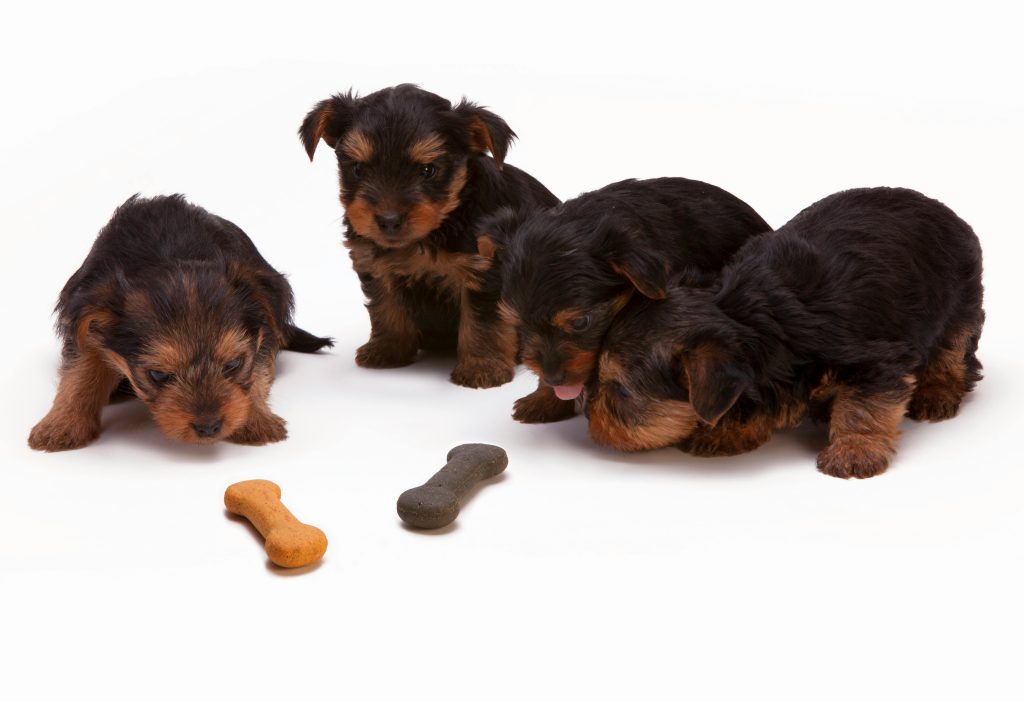
Training treats should be tiny — approximately the size of a pea or smaller. Puppies are highly motivated by food and do not require large treats for reward. Small treats allow many rewards per session without overfeeding.
Count Treat Calories
Treats count toward daily caloric intake. If giving treats regularly — particularly during training sessions — reduce the main meal slightly to compensate. A general guideline is that treats should not exceed ten percent of total daily calories.
Safe Treat Options for Puppies
- Small pieces of cooked chicken or turkey — high value and safe
- Small pieces of cooked sweet potato
- Small pieces of carrot — raw or cooked
- Commercial puppy training treats — look for natural ingredients and low-calorie content
- Puppy-appropriate dental chews once the adult teeth are in, from approximately six months
Treats to Avoid
- Human biscuits and cookies — too high in sugar, salt, and fat
- Processed human snack foods
- Chocolate, grapes, raisins, onions, garlic — all toxic
- Adult dog treats — often too large and too high in calories for puppies
- Rawhide for very young puppies — choking hazard and digestive risk
Common Feeding Problems and Solutions
Puppy Eating Too Fast
As I discovered on that first night, puppies frequently eat very quickly, swallowing food with minimal chewing. This causes vomiting — the stomach fills too rapidly and expels the contents before digestion can begin.
Solutions include slow-feed bowls that force the puppy to eat around obstacles, puzzle feeders that dispense food gradually, spreading food across a licki mat, or dividing the meal into two portions served ten minutes apart.
Puppy Not Finishing Meals
A puppy that consistently leaves food in the bowl may be overfed — reduce the portion slightly. However, a sudden change from finishing meals to leaving food is worth noting — it can be an early sign of illness or stress.
Do not leave uneaten food in the bowl indefinitely. Remove it after fifteen to twenty minutes and offer fresh food at the next scheduled mealtime. This teaches the puppy that food is available at mealtimes — not continuously.
Puppy Seems Constantly Hungry
A puppy that seems perpetually unsatisfied after meals may simply be going through a rapid growth phase with higher caloric needs. Check body condition — if the puppy is underweight or lean, increase the portion slightly. If the puppy is at a healthy weight and simply enthusiastic about food — which is common in highly food-motivated breeds like Labradors — maintain the appropriate portion.
Adding a small amount of plain cooked vegetables — carrot, green beans — to the bowl can increase volume without adding significant calories.
Puppy Refusing Food
Occasional meal refusal in an otherwise well puppy — particularly during hot weather or after an exciting or stressful event — is not usually concerning. A healthy puppy that refuses more than two consecutive meals, or that refuses food alongside other symptoms like lethargy or vomiting, needs veterinary attention.
When to Switch From Puppy Food to Adult Food
The transition from puppy food to adult food should happen when growth is essentially complete — not at a fixed age.
Small breeds — under ten kg adult weight: Transition at approximately nine to twelve months.
Medium breeds — ten to twenty-five kg adult weight: Transition at approximately twelve months.
Large breeds — twenty-five to forty-five kg adult weight: Transition at approximately twelve to fifteen months. Some large breed vets recommend waiting until eighteen months for breeds with particularly long growth periods.
Giant breeds — over forty-five kg adult weight: Transition at approximately eighteen to twenty-four months. Giant breeds have very long growth periods and benefit from remaining on appropriately formulated large breed puppy or all-life-stages food until growth is genuinely complete.
Switching to adult food too early deprives the puppy of the elevated nutrition they need during the remainder of their growth phase. Switching too late provides excess calories and calcium that can contribute to obesity and skeletal problems in large breeds.
When transitioning, use the same gradual approach described in the food transition section above — seven to ten days of mixed feeding.
Puppy Feeding and Toilet Training — The Connection
Scheduled feeding makes toilet training significantly easier — and this practical connection is worth understanding.
Puppies typically need to eliminate within fifteen to thirty minutes of eating. When meals are scheduled and consistent, elimination times become predictable — allowing you to take the puppy outside at the right moment and reward them for eliminating outdoors.
Free feeding makes this predictability impossible. A puppy that eats at random times throughout the day eliminates at random times — making it far harder to be in the right place at the right time during toilet training.
Feed at consistent times. Take the puppy outside immediately after each meal. Wait patiently. Reward enthusiastically when they eliminate outdoors. This simple routine — made possible by scheduled feeding — is the foundation of effective toilet training.
Final Thoughts
Feeding a puppy correctly is one of the most impactful health decisions you make for a dog. The nutrition they receive during the growth phase shapes their skeletal development, immune system, digestive health, and long-term well-being in ways that cannot be entirely corrected later.
The fundamentals are not complicated. Choose a high-quality puppy food formulated for your puppy’s expected adult size. Follow the feeding guide and adjust based on body condition. Feed frequently enough to meet the puppy’s energy needs without overloading their small stomach. Transition foods gradually. Monitor body weight and condition regularly.
And perhaps most importantly, do not do what I did on that first night. Read the feeding guide before you open the bag. Your kitchen floor will thank you.
⚠️ Disclaimer: This article is for informational purposes only and does not replace professional veterinary nutritional advice. For puppies with specific health conditions or unusual growth patterns, always consult a licensed veterinarian.
Sources: American Kennel Club (AKC), Association of American Feed Control Officials (AAFCO), VCA Animal Hospitals, Tufts University Cummings School of Veterinary Medicine
- Best Food for Dogs
- Why Is My Dog Not Eating
- Dog Fever
- cat vaccinations
- cat in pain
- happy cat
- Dog Skin Problems

Stay Updated with Pet Health Tips
Get simple, expert-backed tips, disease alerts, and care guides for your pets—delivered straight to your inbox.