

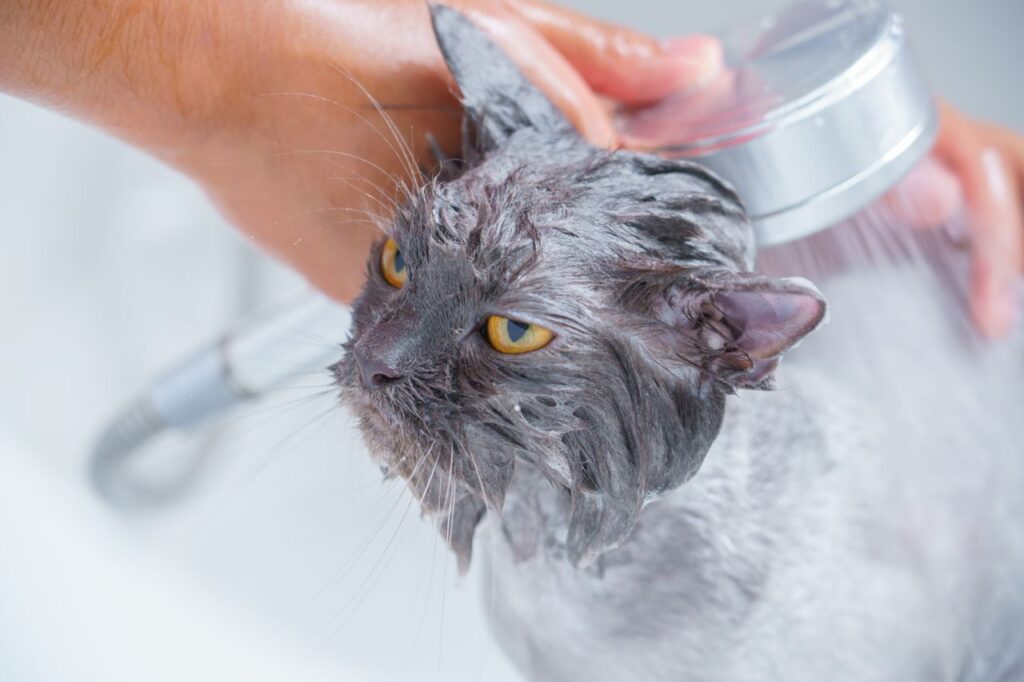
When my sister told me she needed to bathe her cat after he got into something sticky in the garage, I assumed this would be a quick, simple task. After all, how hard could it be?
Within minutes, she had scratches on both arms, the bathroom floor was soaked, and her cat Whiskers had wedged himself behind the toilet, refusing to come out for the rest of the evening.
However, after some research and a few more attempts using a different approach, bath time became calm. The scratches stopped entirely.
Therefore, if you are wondering how to bathe a cat without turning your bathroom into a battlefield, this guide covers everything you need — preparation, technique, products, and specific strategies for cats that genuinely hate water.
Do Cats Actually Need Baths?
Before learning how to bathe a cat, it is worth addressing whether bathing is even necessary, because for most cats, the answer is no.
Cats are exceptionally efficient self-groomers. Their rough tongues, combined with frequent grooming, keep their coats clean under normal circumstances. Furthermore, most healthy cats never need a bath in their entire lives.
However, there are specific situations where bathing becomes necessary:
Visible contamination — if your cat gets into something sticky, oily, toxic, or otherwise impossible to remove through grooming alone.
Long-haired breeds with severe matting — sometimes a bath helps loosen mats before brushing, though severe mats often require professional grooming or clipping.
Senior or arthritic cats — cats with mobility issues may struggle to groom themselves effectively, particularly around the hindquarters. Occasional bathing helps maintain hygiene in these cases.
Obese cats — ats carrying excess weight often cannot reach certain areas of their body to groom. This leads to skin problems that bathing can help manage.
Skin conditions — your vet may recommend medicated baths for specific dermatological conditions.
Severe flea infestations — though flea treatment products are generally more effective than bathing alone.
Therefore, if your cat is healthy, clean, and grooming normally, frequent bathing is unnecessary. It can actually cause more harm than good by stripping natural oils from the skin and coat.
What You Will Need Before You Bathe a Cat
Preparation is everything when it comes to how to bathe a cat successfully. Therefore, gather every item before you begin — once you start, you will not have free hands to search for missing supplies.
Cat-specific shampoo — never use human shampoo or dog shampoo. Cat skin has a different pH balance. Furthermore, many ingredients safe for dogs are toxic to cats. Furthermore, choose a gentle, fragrance-free formula unless your vet has recommended a medicated product.
A small basin, sink, or shallow tub — most cats feel more secure in a smaller space rather than a large bathtub. Additionally, a kitchen sink with a non-slip mat often works better than a full bathtub.
A non-slip mat — placed at the bottom of whatever container you use. This is one of the most important items, as a slippery surface significantly increases anxiety.
A jug or cup for rinsing — controlled pouring is far less startling than a direct spray.
Several large towels — cats shake and thrash when wet, so have more towels ready than you think you will need.
Cotton balls — to gently place in the ears before bathing.
Treats — high-value treats for positive reinforcement before, during, and after.
Protective clothing — long sleeves and, if your cat tends to scratch, gloves designed for handling animals.
A second person, if possible, having someone to help hold, soothe, or hand you items, makes the entire process significantly smoother.
How to Bathe a Cat — Step-by-Step Instructions
Step 1 — Trim Nails Before Bathing
If your cat’s nails are not already trimmed, do this a day or two before the bath — not immediately before, as this adds another stressful event to the same session. Therefore, shorter nails reduce the severity of any scratches during the bath itself.
Step 2 — Brush Thoroughly First
Brush your cat’s coat thoroughly before introducing any water. This is an essential first step in how to bathe a cat with a long or thick coat, because wet fur tangles and mats far more easily than dry fur, and removing loose fur beforehand reduces the amount that ends up in the water.
Step 3 — Prepare the Bathing Area in Advance
Set up everything before bringing your cat into the room. Fill the basin or sink with a small amount of lukewarm water — only a few centimeters deep, just enough to wet the lower body. Furthermore, place the non-slip mat in the bottom before adding water.
Gently insert cotton balls into the ear openings — not deep inside, just enough to reduce water entering the ear canal.
Step 4 — Bring Your Cat in Calmly
Carry your cat into the bathing area calmly, speaking in a soft, reassuring voice. Therefore, avoid any sudden movements or loud noises that could startle them before the bath even begins.
Step 5 — Wet the Body Gradually
Using the jug or cup, pour water gently over your cat’s body, starting from the neck and working backward. Avoid pouring water directly on the head and face — this is one of the most common triggers for panic.
Furthermore, work systematically and calmly, allowing your cat a moment to adjust to the sensation before continuing.
Step 6 — Apply Shampoo
Apply a small amount of diluted cat shampoo and work it through the coat with your fingers, massaging gently down to the skin. Therefore, work from the neck backward, avoiding the face entirely.
For the face, use a separate damp cloth without shampoo to wipe gently around the eyes, nose, and mouth.
Step 7 — Rinse Thoroughly
Rinsing is the step that determines how comfortable your cat feels afterward. Therefore, rinse until you are completely confident all shampoo residue is gone — shampoo left in the coat causes itching and skin irritation, which makes future baths significantly harder.
Work systematically from the neck backward, paying attention to the belly, legs, and base of the tail, where shampoo tends to accumulate.
Step 8 — Wrap Immediately in a Towel
The moment rinsing is complete, wrap your cat in a large, warm towel. Therefore, having the towel within arm’s reach before you start the bath means you can transition immediately from rinsing to wrapping without delay.
Press the towel against the fur to absorb water rather than rubbing, which can cause tangling and increase stress.
Step 9 — Dry Completely
Cats lose body heat quickly when wet. Therefore, complete drying is essential, particularly in cooler weather.
For most cats, towel drying followed by allowing them to retreat to a warm, draft-free space is sufficient. However, for long-haired breeds or in cold conditions, a blow dryer on the lowest heat setting — introduced gradually with treats to build a positive association — can speed up drying significantly.
Many cats are frightened by the sound of a hair dryer. Therefore, never force this on a cat that is already stressed from the bath — towel drying and a warm room are perfectly adequate alternatives.
Step 10 — Reward and Comfort
Once your cat is dry, offer high-value treats and calm praise. Furthermore, allow them to retreat to a familiar, comfortable space to recover from the experience in their own time.
Tips on How to Bathe a Cat That Hates Water
Most cats have an instinctive aversion to water, and learning how to bathe a cat with this aversion requires patience and a gradual approach.
Start With Positive Associations Before Any Bath Is Needed
Long before a bath becomes necessary, get your cat accustomed to having their paws and body handled, to the sound of running water, and to being in the bathroom. Therefore, pairing these experiences with treats builds tolerance over time.
Use the Smallest Adequate Space
A large bathtub feels overwhelming and gives a panicking cat room to thrash and potentially injure themselves. Furthermore, a smaller basin or sink with a non-slip surface feels more secure and is easier to control.
Keep Water Levels Shallow
Only a few centimeters of water is needed for most of the bathing process. Therefore, deep water increases panic significantly and is rarely necessary.
Work Quickly Once Started
While preparation should be thorough and unhurried, the actual bathing process should be efficient once begun. Therefore, having everything ready in advance — as covered above — allows you to move through the steps without unnecessary delays that prolong your cat’s stress.
Consider Waterless Shampoo for Mild Cases
For cats that are mildly dirty rather than significantly contaminated, waterless cat shampoo — applied and then wiped or brushed out — avoids water entirely while still cleaning the coat. Furthermore, this is a useful option for cats with severe water aversion when a full bath is not strictly necessary.
Two-Person Approach
Having one person to gently restrain and soothe while the other handles the washing and rinsing makes the process significantly faster and less stressful for everyone, including the cat.
Know When to Stop
If your cat becomes extremely distressed — excessive vocalization, attempts to escape that risk injury, or signs of genuine panic — it is better to stop, towel off what you can, and try the next day again with a more gradual approach. Therefore, forcing through a severely distressed bath creates lasting negative associations that make future attempts even harder.
Professional Grooming as an Alternative
For cats with extreme water aversion, professional groomers have experience and techniques — including specialized restraint methods used safely and humanely — that can make the process considerably less traumatic than a home attempt. Therefore, this is a reasonable choice rather than something to feel guilty about.
How to Bathe a Cat With Specific Needs
Kittens
Kittens can be bathed from around eight weeks of age if genuinely necessary, though it is rarely required this young. Furthermore, use lukewarm water, a very gentle kitten-safe shampoo, and keep the experience brief and calm — early positive experiences shape lifelong attitudes toward bathing and handling.
Senior or Arthritic Cats
Older cats with mobility issues may need help with hygiene, particularly around the hindquarters. Therefore, a partial bath — focusing only on the areas that need attention rather than a full-body bath — is often more practical and less stressful.
Additionally, a raised surface that does not require the cat to step over a high edge reduces physical strain on arthritic joints.
Cats With Skin Conditions
If your vet has prescribed a medicated shampoo, follow the instructions precisely — these products often require a specific contact time on the skin before rinsing to be effective. Furthermore, do not substitute a different shampoo for a prescribed medicated product.
Long-Haired Breeds
Long-haired cats — Persians, Maine Coons, Ragdolls — benefit from thorough brushing before and after bathing to prevent matting. Furthermore, complete drying is particularly important for these breeds, as a damp undercoat can lead to matting and skin problems if it does not dry fully.
What Not to Do When You Bathe a Cat
Do not use human shampoo — the pH difference causes skin irritation and dryness.
Do not use hot water — lukewarm water is comfortable; hot water can scald sensitive skin and increase distress.
Do not pour water directly on the face — this is one of the most reliable ways to trigger panic.
Do not skip the rinse — residual shampoo causes itching and makes future baths more difficult.
Do not restrain forcefully — this increases panic and creates lasting negative associations.
Do not bathe unnecessarily often — most cats need very few baths in their lifetime, and over-bathing strips protective oils from the skin and coat.
Do not leave your cat wet in a cold environment — cats lose body heat quickly, and a damp, cold cat is at risk of becoming chilled.
When Bathing Reveals a Problem
While bathing — or attempting to — provides an opportunity to check your cat’s skin and coat closely. Therefore, pay attention to:
Lumps or growths — any new mass should be mentioned to your vet.
Skin redness, flaking, or scabbing may indicate allergies, infection, or other skin conditions.
Fleas or flea dirt — often more visible when the fur is wet and parted.
Mats close to the skin — severe matting close to the skin can hide skin problems underneath and may require professional attention.
Unusual odor — a strong smell that persists after bathing may indicate an underlying skin or dental issue rather than simply needing a wash.
If you notice anything concerning, mention it to your vet at the next opportunity.
Final Thoughts
Whiskers’ first bath was a memorable disaster — for everyone involved. However, the second attempt, using a shallow sink, a non-slip mat, a calm approach, and plenty of treats, went smoothly enough that my sister no longer dreads the rare occasions when a bath is genuinely necessary.
Therefore, learning how to bathe a cat successfully comes down to understanding that most cats do not need frequent baths, preparing thoroughly when a bath is necessary, working calmly and efficiently, and recognizing when to stop and try another day.
Most importantly, remember that a calm, well-managed bath — however rare it may be — protects both your cat’s wellbeing and your relationship with them.
⚠️ Disclaimer: This article is for informational purposes only and does not replace professional veterinary advice. If your cat has a diagnosed skin condition, always follow your veterinarian’s specific bathing instructions and product recommendations.
Sources: Cornell Feline Health Center, American Association of Feline Practitioners (AAFP), VCA Animal Hospitals, International Cat Care

Stay Updated with Pet Health Tips
Get simple, expert-backed tips, disease alerts, and care guides for your pets—delivered straight to your inbox.