

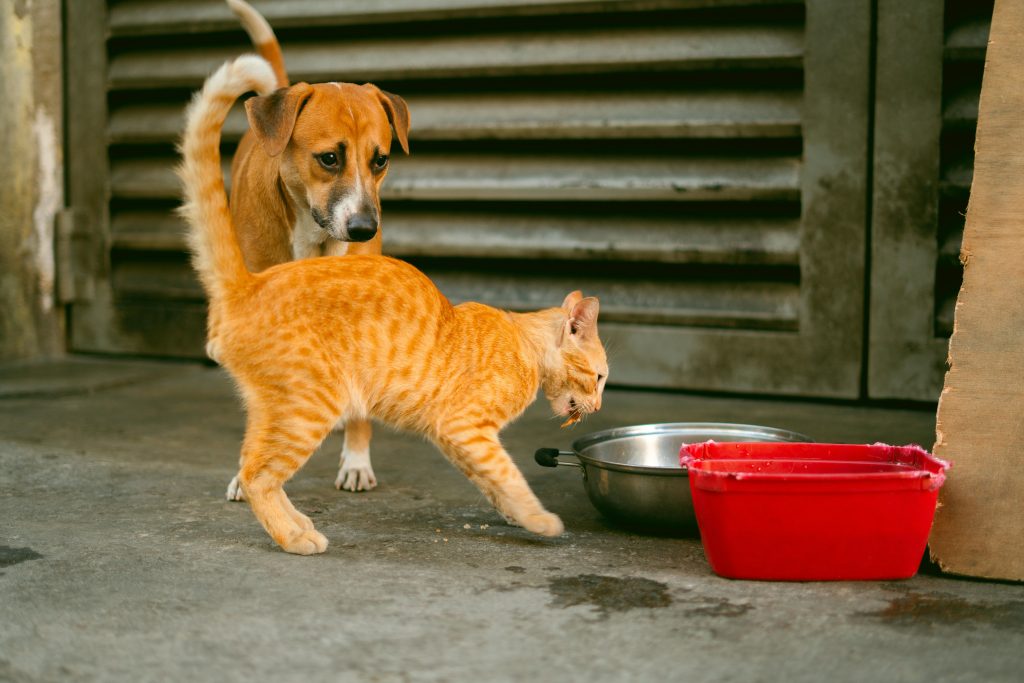
If you have both a cat and a dog at home, you have almost certainly experienced the moment where the cat wanders over to the dog’s bowl and helps themselves to whatever is in it. Or the dog raids the cat’s bowl the moment your back is turned.
It is a scene that plays out in multi-pet households every day. And the question it raises is a genuinely important one — is it safe? Does it matter? And if it does matter, how much?
The short answer is this: a cat eating dog food occasionally is not going to cause immediate harm. But a cat eating dog food regularly — as a primary or significant part of their diet — will develop serious nutritional deficiencies that cause real, lasting health damage over time.
Understanding why requires understanding something fundamental about what cats need — and why dog food, however high quality, simply cannot provide it.
Why Cats Cannot Thrive on Can Cats Eat Dog Food?
The reason cats cannot eat dog food as a regular diet comes down to one biological fact: cats are obligate carnivores, while dogs are omnivores.
This difference is not trivial. It represents a fundamental divergence in metabolic biology that has evolved over millions of years and determines exactly what nutrients a cat must obtain from their food, because its body cannot synthesize them from alternative sources.
Taurine — the Most Critical Difference
Taurine is an amino acid that is essential for cats. It supports heart muscle function, retinal function and vision, reproductive health, immune function, and fetal development.
Dogs can synthesize adequate taurine from other amino acids — cysteine and methionine — in their diet. Cats cannot. Their metabolic pathway for taurine synthesis is so limited that they must consume preformed taurine directly from their food to meet their requirements.
Dog food is formulated to meet the nutritional requirements of dogs — not cats. While reputable dog foods contain some taurine, they do not contain the higher levels required to meet feline needs. Dog food is not required by regulatory standards to contain taurine at the levels needed for cats.
A cat fed dog food as a primary diet will gradually develop taurine deficiency. The consequences are severe and irreversible.
Dilated cardiomyopathy — the heart muscle weakens and enlarges, losing its ability to pump blood effectively. This condition is fatal without treatment and may not be reversible even with treatment if taurine supplementation begins too late.
Retinal degeneration — FCRD — the retina degenerates progressively, leading to vision impairment and eventually blindness. Unlike some forms of eye disease, taurine deficiency-related retinal degeneration is largely irreversible once significant damage has occurred.
Reproductive failure — taurine deficiency in breeding cats causes fetal resorption, stillbirths, and developmental abnormalities in kittens.
Taurine deficiency does not develop overnight. It accumulates gradually over months. By the time symptoms are obvious — a cat that is suddenly breathless, has lost vision, or has audible heart abnormalities — the deficiency has been building for a significant period, and the damage may already be substantial.
Arachidonic Acid
Arachidonic acid is an omega-6 fatty acid that is essential for cats. It supports inflammation regulation, blood clotting, skin and coat health, and reproductive function.
Dogs can synthesize arachidonic acid from linoleic acid, found in plant oils. Cats cannot. They require preformed arachidonic acid from animal fat — specifically from sources like chicken fat, pork fat, and fish.
Dog foods formulated for dogs do not need to contain preformed arachidonic acid because dogs manufacture it themselves. A cat eating dog food long-term will develop arachidonic acid deficiency with consequences for skin health, coat condition, reproductive function, and the inflammatory response.
Vitamin A
Cats cannot convert beta-carotene from plant sources into Vitamin A, which dogs and humans can do. Cats require preformed retinol — Vitamin A in its active form — from animal sources, including liver.
Dog food is formulated to provide adequate Vitamin A for dogs, which may be partially supplied as beta-carotene. A cat eating dog food does not absorb the beta-carotene as usable Vitamin A, potentially leading to deficiency over time.
Vitamin A deficiency in cats causes poor coat condition, impaired vision, particularly in low light, reproductive problems, and impaired immune function.
Protein Content
Cats require significantly more dietary protein than dogs. A cat’s liver enzymes are permanently calibrated to process large amounts of protein — unlike dogs, whose protein metabolism adjusts based on dietary intake.
When a cat consumes a diet low in protein, the liver continues processing protein at its normal high rate — drawing on muscle protein instead. This leads to progressive muscle wasting even when the cat appears to be eating adequate calories.
Dog foods are formulated to meet the protein requirements of dogs, which are substantially lower than the requirements of cats. A cat eating dog food as their primary diet will typically receive insufficient protein to maintain muscle mass over time.
Niacin — Vitamin B3
Cats have a very limited ability to synthesize niacin from tryptophan, an amino acid precursor. They require preformed niacin from their diet. Dog food is formulated for dogs, whose niacin requirements from dietary sources are lower. Long-term feeding of dog food to cats can contribute to niacin deficiency.
What Happens When a Cat Eats Dog Food Regularly
The consequences of a cat eating dog food as a primary diet develop over time, not immediately. This is what makes the situation insidious. The cat may appear normal for months while nutritional deficiencies quietly accumulate.
In the first few weeks: No obvious changes. The cat eats, behaves normally, and appears healthy. The body draws on stored nutrients while gradually depleting reserves.
Over several months, Subtle changes begin. The coat may become dull or less well-maintained. Weight may change slightly. Energy levels may be reduced.
Over six to twelve months, more significant changes develop. A vet examining the cat at this stage may find a heart murmur from developing cardiomyopathy. The retinas may show early signs of degeneration. Muscle wasting may be detectable.
Beyond one year: Overt clinical disease. Heart failure symptoms — breathlessness, exercise intolerance, fluid accumulation. Significant vision impairment or blindness. These conditions are serious and may be irreversible.
This progression means that by the time a cat owner realizes something is wrong and connects it to the diet, significant irreversible damage may already have occurred.
What About Occasional Eating?
A cat that occasionally eats a few bites of dog food — because they walked over to the dog’s bowl and had a taste — is not in danger. A single exposure or an occasional small amount does not cause nutritional deficiency.
The problem is regular, habitual eating of dog food — whether because the owner feeds it intentionally, because the cat consistently accesses the dog’s bowl, or because dog food is used as a substitute when cat food runs out.
If your cat occasionally snacks from the dog’s bowl, the practical response is to feed the pets separately and prevent regular access to each other’s bowls. It is not a medical emergency. But it is worth addressing to prevent it from becoming a habit.
Can cats eat dog food?
The reverse situation — dogs eating cat food — deserves mention since it commonly occurs in the same households.
Dogs eating cat food occasionally is not dangerous in the way cats eating dog food is, because cat food is higher in protein and fat than dog food, rather than deficient in essential nutrients dogs require.
However, regular eating of cat food by dogs is not appropriate for different reasons:
Too high in protein for long-term use — the very high protein content of cat food places unnecessary strain on a healthy dog’s kidneys and liver over the long term.
Too high in fat — cat food’s higher fat content can trigger pancreatitis in dogs predisposed to this condition — a serious and painful inflammation of the pancreas.
Not balanced for dogs — cat food is formulated to meet feline nutritional requirements, not canine. It may be deficient in certain nutrients that dogs require.
Weight gain — the higher caloric density of cat food contributes to obesity in dogs that eat it regularly.
Feed both species their species-appropriate food and manage access to prevent regular cross-species feeding.
Managing Feeding in a Multi-Pet Household
Preventing cats from eating dog food and dogs from eating cat food requires some practical management.
Feed Separately
The simplest solution is to feed the animals in separate rooms or at separate times. Feed the cat, watch them eat, and remove the bowl when finished. Then feed the dog. Alternatively, use a room with a door the dog cannot pass through for the cat’s meals.
Use Elevated Feeding Stations
Cats naturally prefer elevated eating spots. A feeding station on a counter, shelf, or dedicated cat table that the dog cannot reach allows the cat to eat at their own pace without the dog accessing their bowl.
Use Microchip-Activated Feeders
Microchip feeders — bowls with lids that open only in response to a specific microchip — ensure only the registered pet can access that bowl. These are particularly useful for cats that graze on dry food throughout the day when the owner is not present to supervise.
Feed Measured Meals
Free-feeding — leaving food available at all times — makes cross-species feeding much harder to control. Feeding measured meals at specific times, supervising until each animal finishes, and removing the bowls immediately after, eliminates most opportunities for cross-access.
Pick Up the Dog’s Bowl
After the dog finishes eating, pick up the bowl immediately rather than leaving it accessible. A clean, empty bowl is significantly less tempting to a passing cat.
Recognizing Nutritional Deficiency in Dog Food Feeding
If you have been feeding a cat dog food — or if you have recently adopted a cat and are unsure what they were fed previously — watch for these signs of potential nutritional deficiency:
Heart-related signs:
- Breathlessness — the cat breathes faster than normal at rest or after minimal activity
- Exercise intolerance — the cat tires very quickly
- Weakness or collapse
- Open-mouth breathing in a resting cat is always abnormal and concerning
- A heart murmur was detected during a veterinary examination
Eye-related signs:
- Dilated pupils that do not respond normally to light
- Bumping into objects
- Apparent difficulty navigating in low light
- Behavioral changes suggesting reduced vision
General signs:
- Dull, poor-condition coat
- Progressive muscle wasting despite eating
- Poor growth in kittens
- Reproductive problems in breeding cats
If a cat has been eating dog food regularly and shows any of these signs, a veterinary examination is urgently needed. Blood tests to assess taurine levels and a cardiac examination, including echocardiography, are appropriate first steps.
Transitioning a Cat From Dog Food to Cat Food
If you discover your cat has been eating dog food primarily — either because of an inadvertent error, a household where food was shared, or a previous owner’s practice — transitioning to appropriate cat food requires care.
Do not switch abruptly. An abrupt diet change causes digestive upset — vomiting and diarrhea — particularly in a cat whose digestive system has adapted to dog food.
Transition gradually over seven to ten days — mixing increasing proportions of cat food with decreasing proportions of dog food until the transition is complete.
During and after the transition, schedule a veterinary examination to assess the cat’s nutritional status and check for early signs of taurine deficiency. Early detection allows intervention before significant irreversible damage occurs.
Emergency Situations — Running Out of Cat Food
A practical question: what should you feed a cat if you run out of cat food and cannot get to a shop immediately?
Plain, cooked chicken — boneless, skinless, with no seasonings — is the safest immediate option. It is high in taurine, high in protein, and generally well-accepted by cats.
Plain, cooked fish — particularly tuna or salmon cooked without seasonings — is another acceptable short-term option.
Plain, cooked eggs — a source of complete protein, acceptable for a meal or two.
Plain, unseasoned cooked meat — turkey, beef, or lamb without any additions.
These are short-term solutions for one or two meals. Do not use dog food as a substitute, even in an emergency, if you have any of the above alternatives available.
If none of the above are available, one or two meals of dog food in an absolute emergency will not cause harm. But replace with appropriate cat food as quickly as possible.
Final Thoughts
The bowl confusion that happens in multi-pet households is understandable — and almost universal. But the nutritional differences between cats and dogs are profound enough that regular cross-species feeding has real and serious health consequences.
Cats are not small dogs. Their nutritional requirements are genuinely different in ways that cannot be met by a food formulated for a different species, however high-quality that food is.
Keep the bowls separate. Feed each animal their species-appropriate diet. And take the occasional stolen mouthful from the other bowl in stride — as the minor, harmless event it is when it stays occasional.
The distinction matters because your cat’s heart, eyes, and long-term health depend on it.
⚠️ Disclaimer: This article is for informational purposes only and does not replace professional veterinary nutritional advice. If you suspect your cat has been eating dog food regularly and shows signs of illness, consult a licensed veterinarian promptly.
Sources: Cornell Feline Health Center, American Association of Feline Practitioners (AAFP), VCA Animal Hospitals, Association of American Feed Control Officials (AAFCO)
- Best Food for Dogs
- Why Is My Dog Not Eating
- Dog Fever
- cat vaccinations
- cat in pain
- happy cat
- Dog Skin Problems

Stay Updated with Pet Health Tips
Get simple, expert-backed tips, disease alerts, and care guides for your pets—delivered straight to your inbox.